Bilibili: China’s Digital Home for a New Generation
Posted 1 month ago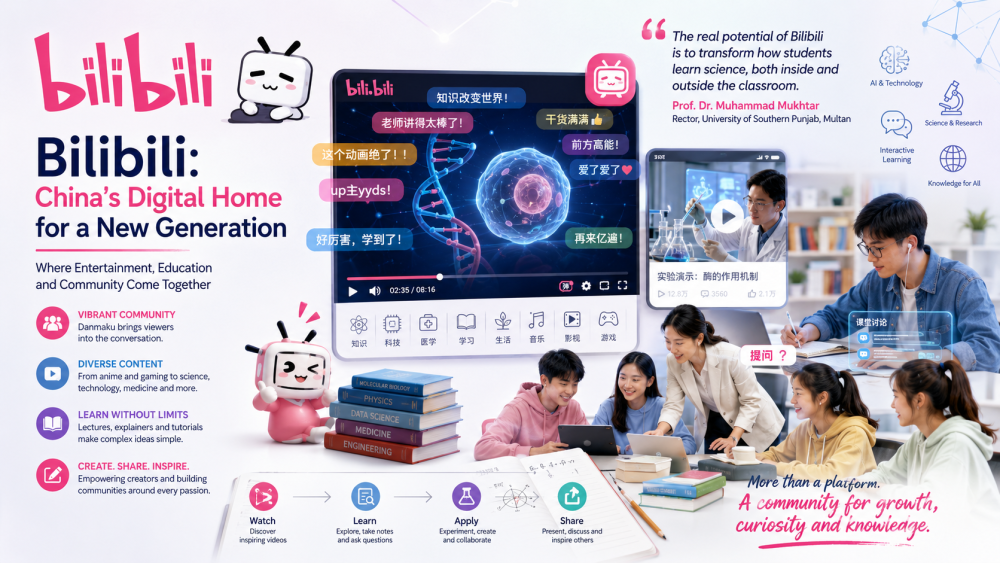
196/2026
In China’s rapidly evolving digital landscape, Bilibili has grown from a niche community for anime and gaming enthusiasts into one of the country’s most influential platforms for video, culture, education, and entertainment.
Founded in 2009, Bilibili is often compared to YouTube, but that comparison tells only part of the story. Its identity is shaped by a highly engaged community, a youthful culture, and a distinctive commenting system known as “danmaku,” real-time comments that scroll across the screen as a video plays. Rather than simply watching content, viewers become part of a shared digital conversation.
Bilibili's content has expanded far beyond animation and games. Today, users can find videos covering science, technology, medicine, education, history, music, film, programming, and everyday life. University lectures and educational explainers coexist with gaming streams, creative productions, and entertainment.
This educational dimension is particularly notable. For millions of young Chinese viewers, Bilibili has become a place not only to be entertained but also to learn, explore, and develop new skills. Complex subjects can be presented through animations, demonstrations, and creator-led explanations that make difficult ideas more accessible.
The platform's strength lies in its community. Unlike traditional television, where audiences largely consume professionally produced programs, Bilibili encourages users to create, comment, remix, and share. Successful creators can build highly dedicated audiences around specialized interests.
Bilibili has therefore become more than a video website. It reflects a broader shift in how younger generations consume information, participate in communities, and learn online.
For scientists, educators, and science communicators, Bilibili is an increasingly compelling platform. A compelling explanation of a medical discovery, an animation showing how a drug works, or a short demonstration of a scientific experiment can reach audiences that conventional academic publishing rarely reaches.
Its story also illustrates a broader transformation taking place across the internet: the boundary between entertainment, education, and social interaction is disappearing.
Bilibili's greatest achievement may be making learning feel less like attending a classroom.
“The real potential of Bilibili is not merely to communicate scientific discoveries to the public. Its greater opportunity may be to transform how students learn science, both inside and outside the classroom.” Prof. Dr. Muhammad Mukhtar, Rector, University of Southern Punjab, Multan
According to Prof. Dr. Muhammad Mukhtar, Bilibili offers an important glimpse into the future of education, where video, interaction, artificial intelligence, and scientific knowledge converge. Its significance therefore extends well beyond science popularization.
“Education is shifting from a model in which knowledge is delivered primarily by the teacher to one in which students continuously discover, question, and construct knowledge,” he observes. “Platforms such as Bilibili can become an important part of this transformation.”
The potential classroom applications are substantial. A biology teacher could use a professionally produced animation to demonstrate how a cell divides; a physics teacher could visualize electromagnetic fields; a medical instructor could demonstrate how a heart valve functions; and an engineering student could watch a real laboratory demonstration before entering the lab.
Bilibili's interactive culture could make this approach even more effective. Students can watch a scientific explanation before class, take notes, post questions, and discuss difficult concepts. Teachers can then use classroom time for problem-solving, experiments, debates, and deeper exploration. This approach aligns with the principles of the flipped classroom, but with a much larger ecosystem of publicly available video resources.
Research is already finding evidence of this educational potential. Studies have shown that Bilibili users use videos, notes, and comments as informal learning resources, while recent research has examined their use for high school physics and scientific paper reading.
Prof. Mukhtar sees another important possibility: connecting students directly to the world of research.
“A university student should not encounter science only through a textbook,” he says. “Students should be able to see how scientists think, how experiments are conducted, how research papers are interpreted, and how discoveries move from laboratories to society.”
That could make Bilibili particularly valuable for higher education. Researchers and professors could create short explainers, lab demonstrations, paper walkthroughs, and visual lectures. Students could learn not only what scientists discovered but also how scientific knowledge is produced and evaluated. Recent research on Bilibili has already documented scientists using videos to teach students how to read research papers and understand publication practices.
For schools and universities, Prof. Mukhtar emphasizes that adoption should be curated rather than indiscriminate. Teachers would need to select reliable content, align videos with learning outcomes, and distinguish evidence-based science from speculation or misinformation. Research on medical videos on Bilibili also highlights this challenge: expert-produced material tends to be more reliable, while the overall quality of some health content remains uneven.
The future, therefore, may not be about replacing textbooks, teachers or laboratories with social media. It may be about connecting them.
A student could encounter a scientific question in a Bilibili video, investigate it using a textbook or research paper, discuss it with classmates, test it through an experiment, and finally present a conclusion to the class. In this learning cycle, digital media becomes the starting point for inquiry rather than the endpoint of learning.
“Technology should not make teachers less important,” Prof. Mukhtar argues. “It should make teachers more valuable as mentors, interpreters, critical thinkers, and guides who help students distinguish knowledge from information.”