At Global Launch Event on ‘Integrating AI in TVET,’ NSU Vice Chancellor Outlines Pakistan’s Roadmap for AI in Technical Education
Posted 3 months ago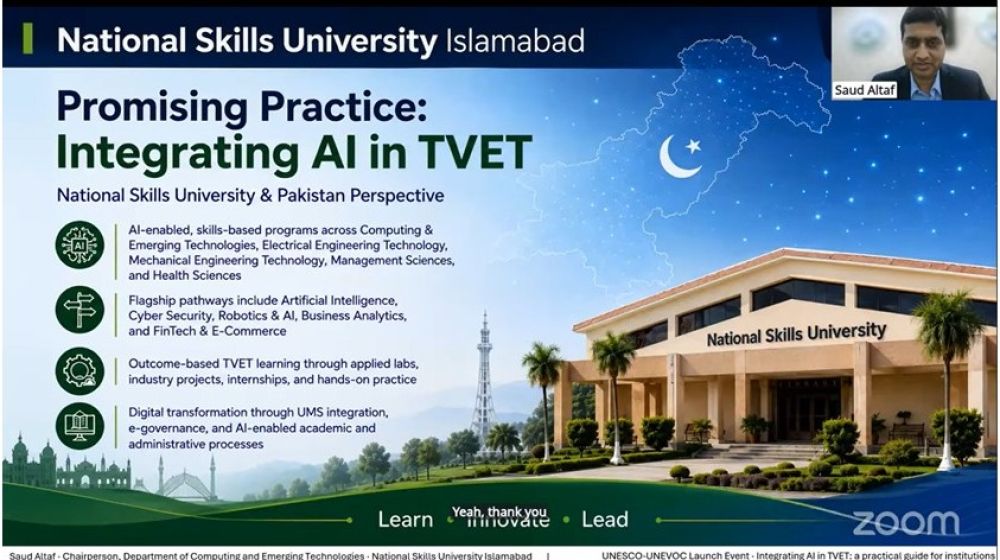
114/2026
Event video is available HERE
Artificial intelligence should not be confined to a single classroom or academic discipline. Instead, it must become the operating framework for how universities teach, manage, innovate, and solve real-world problems. That was the central message from Prof. Dr. Saud Altaf, Vice Chancellor of the National Skills University (NSU) Islamabad, at the UNESCO-UNEVOC international launch event, "Integrating AI in TVET: A Practical Guide for Institutions."
Addressing educators, policymakers, and technical education experts, Prof. Altaf presented National Skills University as a model for embedding artificial intelligence across institutional systems, rather than treating it as an isolated academic subject. His remarks reflected a broader vision emerging in Pakistan's technical education landscape, one that views AI as an enabler of workforce transformation rather than merely a field of study.
At the outset of his address, the Vice Chancellor acknowledged the pioneering contributions of Prof. Dr. Muhammad Mukhtar, NSU's Founding Vice Chancellor, whose leadership established the university's philosophy of innovation, industry engagement, and skills-driven education.
"Artificial intelligence should not be taught merely as a subject," Prof. Altaf emphasized. "It must become a tool integrated throughout the educational ecosystem from classrooms and laboratories to administration, research, and real-time problem-solving."
That philosophy, he explained, is already shaping NSU's academic landscape. The university has introduced programs and initiatives spanning Artificial Intelligence, Cybersecurity, Robotics, Business Analytics, FinTech, E-Commerce, and other emerging technologies. Rather than emphasizing theoretical instruction alone, students are expected to apply AI to practical industrial challenges through applied laboratories, internships, industry collaborations, and capstone projects.
One hallmark of this approach, he noted, is that final-year students routinely develop AI-enabled applications that address real-world problems, reinforcing the university's commitment to outcome-based education and innovation.
Prof. Altaf also highlighted an AI-based Skill Mapping Project that he is leading to identify future workforce demands, align technical competencies with industry requirements, and support evidence-based planning for Pakistan's rapidly evolving labor market.
Despite these advances, the Vice Chancellor cautioned that the successful integration of AI into Pakistan's education system depends on overcoming three interconnected challenges.
The first, he said, is faculty capacity. Universities must invest substantially in preparing teachers to integrate AI into teaching, research, and assessment confidently. Without a digitally empowered faculty, technological transformation will remain superficial.
The second challenge is infrastructure. Artificial intelligence depends on reliable digital ecosystems, including high-speed internet connectivity, modern computing facilities, cloud services, and institutional digital platforms. Many institutions still face significant resource constraints that limit effective AI adoption.
The third and perhaps most complex challenge is curriculum transformation. Prof. Altaf argued that educational programs must evolve continuously to keep pace with the rapid development of AI technologies and shifting industry expectations. Static curricula can no longer prepare graduates for dynamic labor markets increasingly shaped by intelligent systems.
Alongside technological advancement, the Vice Chancellor underscored the importance of the responsible and ethical use of artificial intelligence, urging institutions to promote transparency, accountability, and integrity and to prepare students to harness AI for the public good.
He also commended the Government of Pakistan for advancing the National AI Policy, calling it a significant milestone that provides universities with strategic direction to expand AI education, research, innovation, and digital transformation nationwide.
Throughout his presentation, Prof. Altaf returned to a central theme: the future of technical and vocational education lies not merely in producing graduates familiar with AI, but in creating institutions where artificial intelligence strengthens every dimension of learning, governance, and industry engagement.
As Pakistan accelerates its digital transformation, National Skills University is positioning itself as an institution where AI is woven into the fabric of technical education—equipping graduates not only to understand emerging technologies but also to apply them to solve the complex challenges of the modern economy.