Why One of the World's Most Digital Nations Is Turning Back to Printed Books?
Posted 3 months ago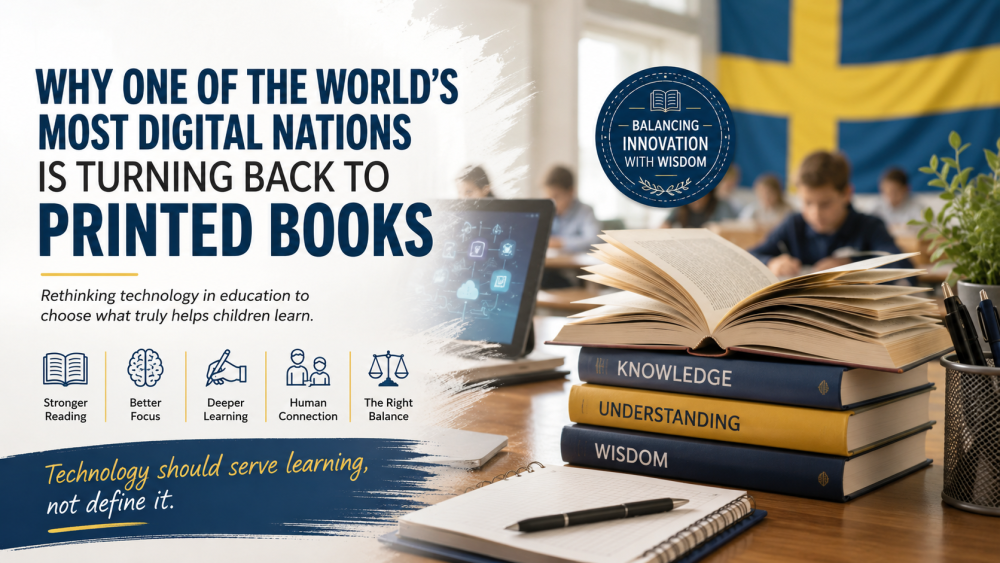
126/2026
By rethinking the role of technology in education, Sweden is reminding the world that innovation is not about replacing old tools but about choosing the right ones.
For nearly two decades, schools around the world raced toward an increasingly digital future. Classrooms are filled with tablets, laptops, interactive whiteboards, cloud-based homework, and educational apps. Paper textbooks began to disappear, replaced by glowing screens that promised personalized learning and limitless information.
Now, one of the world's most technologically advanced nations is asking an unexpected question:
What if we went too far?
Sweden, long admired for embracing digital innovation, is reversing course. Rather than giving every child another screen, it is investing millions in printed textbooks and encouraging teachers to use pens, paper, handwriting, and more face-to-face learning. The move follows growing concerns that heavy reliance on digital devices may have unintentionally weakened children's reading, concentration, and fundamental learning skills.
This is not a rejection of technology.
It is a reminder that technology should serve learning, not define it.
The Digital Dream
The original vision seemed irresistible.
Digital classrooms promised customized lessons, instant access to information, interactive exercises, artificial intelligence tutors, and lower printing costs. Children could carry an entire library on a lightweight tablet.
For countries seeking to modernize education, it looked like an obvious step forward.
Sweden became one of the pioneers. Many schools quickly replaced traditional textbooks with digital materials, assuming that more technology would naturally lead to better learning.
But education, like medicine, often produces surprises.
When More Technology Doesn't Mean Better Learning
Teachers gradually began noticing subtle changes.
Many students struggled to read lengthy passages without becoming distracted. Some skimmed rather than read carefully. Others found it harder to retain information or concentrate during lessons.
Researchers have increasingly reported that reading on paper and reading on screens are not always equivalent experiences.
Reading from paper often helps people build a stronger mental map of the text. They can remember where information appears on a page, annotate the margins more naturally, and experience fewer digital distractions. Screens, by contrast, often encourage rapid scanning rather than deep reading, especially when notifications, hyperlinks, or multitasking compete for attention.
No single study proves that digital devices are harmful. Yet together, a growing body of evidence suggests that how we learn matters just as much as what we learn.
Books Exercise the Brain Differently
Imagine learning to play the piano.
Watching videos about music is useful.
Listening to performances is inspiring.
But eventually, your fingers must touch real keys.
Learning works similarly.
Writing by hand engages multiple brain regions simultaneously. The movements required to form letters strengthen memory and reinforce understanding. Reading printed pages slows us down just enough to encourage reflection rather than constant scrolling.
These are not nostalgic habits.
They are biological ones.
The human brain evolved long before smartphones.
A Better Balance
Perhaps the most important lesson from Sweden is that this is not a battle between books and technology.
Digital tools remain extraordinarily valuable.
They help students visualize complex scientific concepts, collaborate across continents, access vast digital libraries, and support learners with disabilities. Artificial intelligence is opening up remarkable new possibilities for personalized education.
But every tool has its strengths.
Calculators did not eliminate the need to learn arithmetic.
GPS did not eliminate the importance of understanding geography.
Likewise, tablets cannot replace every educational experience offered by printed books.
The most effective classrooms may combine both worlds.
Quality Teaching Matters More Than Gadgets
One misconception has persisted for years: if schools buy enough technology, educational outcomes will automatically improve.
Reality is more complicated.
Excellent teachers inspire curiosity regardless of whether students use chalkboards or tablets.
Poor teaching cannot be fixed with more expensive devices.
Educational success depends on thoughtful curriculum design, motivated teachers, supportive families, and learning environments that encourage attention and critical thinking.
Technology is an amplifier—not a substitute.
Lessons for Countries Building Digital Education
For developing nations investing heavily in educational technology, Sweden's experience offers a valuable caution.
Modernization should never become digitization for its own sake.
Before replacing books with screens, policymakers should ask:
- Will this improve comprehension?
- Will it strengthen literacy?
- Will students think more deeply?
- Will teachers receive proper training?
- Is this solving an educational problem—or simply following a technological trend?
Innovation requires evidence, not just enthusiasm.
The Future May Look Surprisingly Familiar
Ironically, the future classroom may resemble a thoughtful blend of old and new.
Students may use artificial intelligence to explore scientific ideas, virtual laboratories to conduct experiments that are impossible in school buildings, and digital platforms to collaborate globally.
Then they may close the laptop.
Open a printed book.
Pick up a pencil.
And begin writing.
Far from signaling a retreat from progress, Sweden's decision suggests a more mature understanding of technology. The smartest societies are not those that adopt every new tool without question. They are the ones willing to ask whether those tools truly help people learn.
Sometimes, the most innovative idea is not adding another screen.
Sometimes, it is remembering why books have remained humanity's greatest source of learning technology.