When Artificial Intelligence Starts Policing Scientific Publications
Posted 5 months ago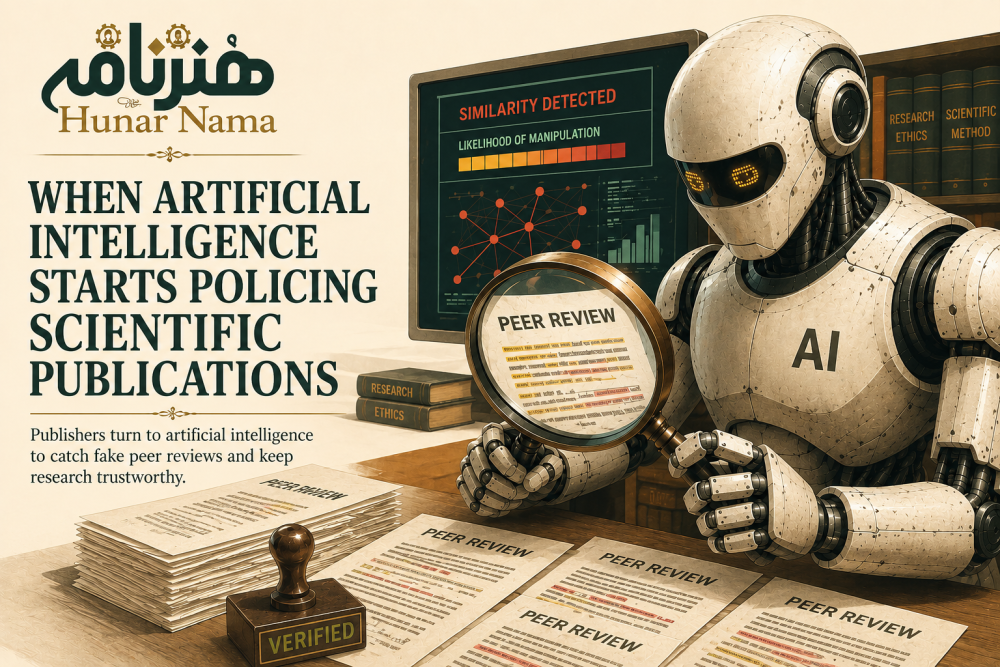
64/2026
Science has long relied on a fragile system built largely on trust. Researchers trust that experiments were conducted honestly. Journals trust that reviewers are genuine experts. And the public trusts that published science has undergone rigorous scrutiny before entering textbooks, hospitals, and public policy.
But that trust is beginning to crack.
A new report in the journal Nature describes how publishers are now turning to artificial intelligence to detect suspicious peer reviews. These confidential evaluations determine whether scientific papers are accepted or rejected. The reason is troubling: fake reviews and manipulated publishing practices are increasingly difficult for humans alone to detect.
For decades, peer review was treated almost as a sacred ritual of academia. A scientist submits a paper. Experts in the field quietly examine it. Errors are flagged, weak conclusions challenged, and sometimes entire studies rejected. The process is imperfect, but it has long been considered the backbone of scientific credibility.
Now imagine discovering that some of those reviews were never truly independent.
In some cases, reviewers have allegedly copied and pasted identical comments across multiple papers. In others, fabricated reviewer identities were reportedly used to push papers through the system. The result is not merely academic misconduct; it threatens the reliability of science itself.
This is where artificial intelligence enters the story, not as a writer of scientific papers but as a detective.
The newly introduced AI system scans peer-review reports for suspicious similarities, repeated wording, and unusual patterns that humans might overlook. Think of it as plagiarism detection but aimed at the review process itself. Instead of asking whether a student copied an essay, the software asks whether supposedly independent scientific evaluations look unnaturally alike.
There is a certain irony here. In recent years, many educators and researchers worried that AI tools such as ChatGPT might undermine academic integrity. Now the same technology is being used to defend it.
The timing could not be more critical. Scientific publishing is under immense strain. Researchers face relentless pressure to publish quickly. Universities reward publication counts. Journals are flooded with submissions. Reviewers, already overworked, struggle to keep pace. In this environment, shortcuts and manipulation become tempting.
The consequences extend far beyond universities.
A flawed medical paper can influence patient treatment. Weak environmental research can shape climate policy. Poor-quality science can fuel misinformation online. During the COVID-19 pandemic, the public saw in real time how quickly questionable studies could circulate and affect public debate. Trust, once lost, is difficult to rebuild.
Artificial intelligence alone will not solve the crisis. Algorithms can identify suspicious patterns, but they cannot fully replace human judgment, ethics, or expertise. An AI system might flag similarities among reviews, but editors must still investigate whether misconduct occurred. Used carelessly, automated policing could also lead to false accusations or unfair suspicion.
Yet the broader message is unmistakable: science is entering an era where even the guardians of knowledge require oversight.
In many ways, this moment reflects a deeper transformation unfolding across society. Artificial intelligence is no longer confined to futuristic laboratories or Silicon Valley startups. It is quietly becoming an auditor, referee, and gatekeeper in institutions once governed almost entirely by human trust.
Banks use AI to detect fraud. Governments use it to monitor cyber threats. Hospitals increasingly rely on algorithms to identify diagnostic errors. Now, scientific publishing is joining the list.
That should make us pause.
For centuries, science advanced because people believed in a shared culture of honesty and verification. The growing need for AI surveillance in academia suggests that this culture is under pressure. Technology may help protect the system, but it also reveals how vulnerable it has become.
Perhaps the most important lesson is not about artificial intelligence at all. It is about the growing difficulty of preserving integrity in an age defined by speed, competition, and information overload.
Science still works remarkably well compared with most human institutions. Breakthroughs in vaccines, genetics, cancer research, and climate science continue to save and improve lives every day. But the scientific enterprise depends on credibility. Without trust, even the best discoveries risk being met with suspicion.
The rise of AI watchdogs in academic publishing is therefore both reassuring and unsettling. Reassuring because new tools are emerging to detect fraud. Unsettling because the need for such tools has become unavoidable.
To conclude, the real challenge is not teaching machines to detect dishonesty. It is ensuring that human beings still value truth enough to make such policing less necessary in the first place.