Talenteria and the Future of Talent Acquisition: How AI Can Transform Recruitment and Where Human Judgment Still Matters
Posted 1 month ago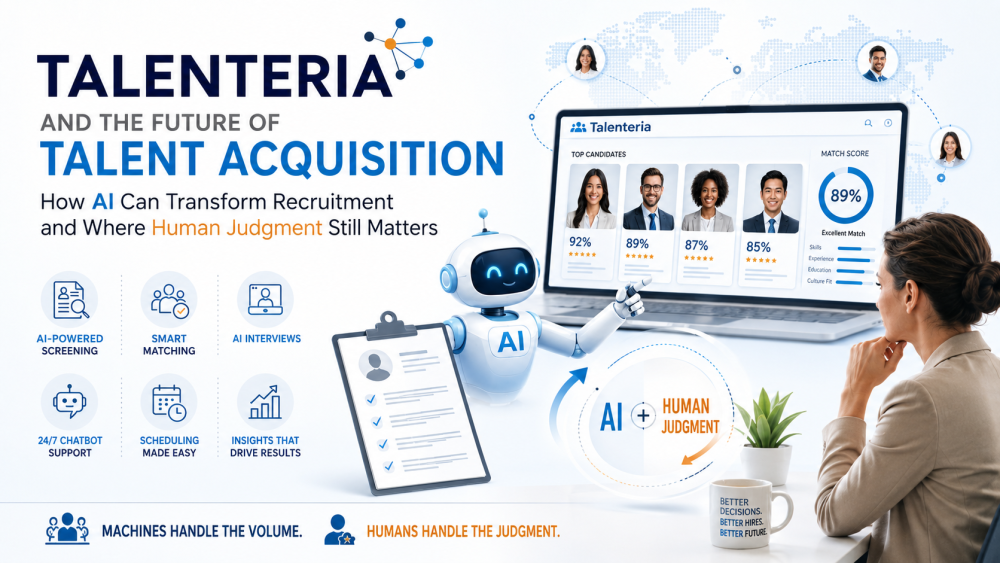
189/2026
Hiring for any organization has long been a people-intensive process. Recruiters may spend hours reading resumes, shortlisting applicants, arranging interviews, and answering routine questions, only to discover that the best candidate was buried somewhere in a pile of applications.
Artificial intelligence is beginning to change that equation. Talenteria is an AI-powered recruitment platform that can help organizations screen, match, and engage candidates more efficiently. But can AI really find the right person for a job? The answer is more complicated and more interesting than a simple yes or no.
From Resume Piles to Intelligent Shortlists
At its simplest, Talenteria acts like an intelligent recruitment assistant. It can analyze resumes, compare candidates with job requirements, identify potentially suitable applicants, and help recruiters organize the talent pool. The company says its technology can process resumes in more than 50 languages and evaluate candidates using contextual information rather than relying only on keywords.
Imagine a university receiving 500 applications for 10 faculty positions. Instead of asking recruiters to review every resume manually, AI can conduct the first round of analysis and identify candidates whose education, experience, and skills appear relevant. The recruiter can then focus on the strongest candidates rather than on repetitive administrative work.
That is perhaps AI’s greatest promise in recruitment: not replacing the recruiter but giving the recruiter more time to think.
AI Can Also Conduct the First Interview
Talenteria also offers AI-assisted video and voice interviews. Candidates can respond to predefined questions, and recruiters receive structured information to support initial screening. This could be especially useful when hundreds of people apply for the same position.
Instead of scheduling hundreds of preliminary interviews, an organization could allow candidates to complete an initial assessment at a convenient time. Human recruiters could then focus on applicants who merit further consideration. This approach could make recruitment faster, more scalable, and potentially more accessible across geographical boundaries.
A 24-Hour Recruitment Desk
AI can also improve candidate experience. Recruitment chatbots can answer routine questions, provide information about vacancies, and help candidates navigate the application process. Talenteria also provides candidate-engagement and scheduling capabilities. For applicants, this means they don't necessarily have to wait until a recruiter is available to get basic information. For employers, it means that recruitment communication can continue outside conventional working hours.
The Hidden Advantage: Finding People You Already Have
One of the more interesting possibilities is AI-powered candidate matching. A candidate who was not selected for one position may be an excellent fit for another. Instead of losing that person permanently, an intelligent recruitment system can help organizations rediscover suitable candidates when new positions become available. This turns recruitment from a series of isolated hiring exercises into something closer to a long-term talent ecosystem.
But AI Is Not Neutral
Here is where the story becomes more complicated. AI can process information quickly, but speed does not guarantee fairness. If historical recruitment data contain human biases, an AI system trained or configured on those data can reproduce them. Researchers and institutions, including the International Labor Organization and the U.S. National Institute of Standards and Technology, have warned that AI systems can produce biased outcomes when data, objectives, or system design are flawed.
Another danger is false precision.
A candidate receiving an AI score of 86 may appear objectively better than someone scoring 78. But those numbers can hide complex assumptions about what makes a successful employee. A brilliant researcher may have an unconventional resume. A highly capable teacher may not perform well in an automated interview. Someone from a different cultural or linguistic background may communicate differently without being less capable. AI can identify patterns. It does not truly understand human potential.
The Right Formula: AI + Human Judgment
This is why the most sensible approach is not to let AI make the final hiring decision.
A better model is:
AI screens → AI organizes → AI recommends → humans investigate → experts decide.
Talenteria itself emphasizes an AI-augmented approach in which recruiters remain involved in the final decision. This distinction matters because employment decisions can have profound consequences. The European Union's AI Act treats certain AI systems used for recruitment and selection as high-risk, reflecting the potential impact of these technologies on people's careers and fundamental rights.
So, Is Talenteria Worth Using?
For organizations handling large numbers of applicants, potentially yes. Its strongest advantages are speed, scalability, automated screening, candidate matching, communication, and freeing recruiters from repetitive work. Its weaknesses are equally important: AI can inherit bias, produce misleading scores, overlook unconventional talent, and raise legitimate questions about privacy, transparency, and accountability.
The best way to use Talenteria is therefore not to ask:
“Can AI choose our employees?”
but:
“Can AI help our people make better hiring decisions?”
That is a much more realistic and ultimately much more powerful question.
The future of recruitment may not be a world where machines replace human recruiters. It may be one where machines handle the volume, while humans handle the judgment, making hiring not only faster but potentially more thoughtful.
According to Rais Nouman Ahmad, Assistant Professor of Law, Bahauddin Zakriya University, Multan, Pakistan,
"The post responsibly emphasizes human judgment retention and acknowledges algorithmic bias risk. Reference to the EU AI Act's high-risk classification demonstrates awareness of regulatory frameworks. The formula "AI screens → recommends → humans decide" reflects sound governance principles.
Regulatory Concerns: First, no algorithmic impact assessment or transparency disclosure precedes deployment. Second, the evaluation criteria for "contextual information" are vague, risking obscured bias. Third, no candidate right to explanation or appeal mechanism exists. Fourth, it mentions no audit trail requirements or bias-testing protocols. Fifth, it does not discuss Pakistan's DNA 2025 or data minimization safeguards for recruitment data.
Recommendation: Platforms deploying algorithmic recruitment require independent bias audits, candidate explanations, and regulatory coordination under Pakistan's emerging digital governance framework.