Reading the World Through Touch: University of Southern Punjab Marks World Braille Day in Multan
Posted 8 months ago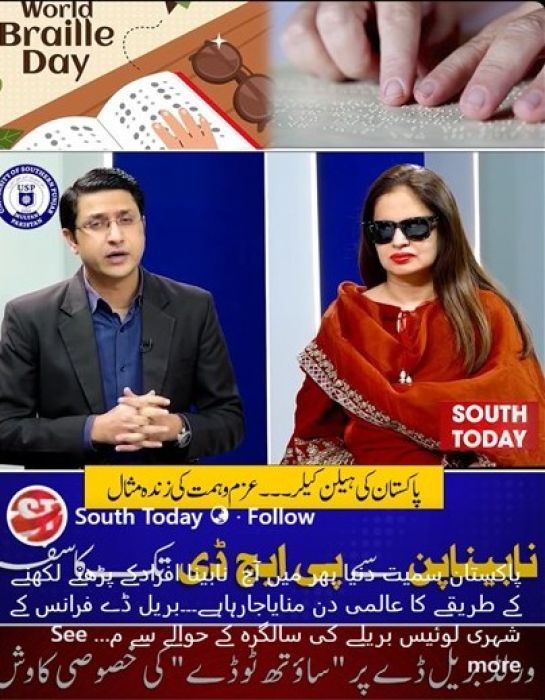
3/2026
The University of Southern Punjab and South Today join with the rest of the World to commemorate World Braille Day 2025.
This wasn’t just an interview. It was a story of courage, belonging, and global citizenship, crafted as part of a thoughtful initiative by the University of Southern Punjab Multan, in collaboration with South Today, to commemorate international days and reaffirm Pakistan’s role in a shared human story. On World Braille Day, that story was voiced through Dr. Shahida Rasool, Assistant Professor at Women’s University, Multan.
She began not with triumph, but with truth.
Her journey, she said softly, was never easy. When you cannot see, you begin life dependent on others—not for sympathy, but for information. In the early days, the World reached her only through sound: voices, footsteps, silences. There were no colors, no faces—only listening. “I tried to discover myself through listening,” she reflected, as if listening itself had become her way of seeing.
Her formal learning journey started at Ibn-e-Qasim Blind School, Multan, where a whole new world unfolded—one made up of raised dots and patient fingers. This was her first experience with Braille, a system that turned darkness into language and isolation into opportunity. Her parents allowed her to go to school despite doubts; they were not concerned about her abilities but about society’s limited imagination.
One moment, however, changed everything.
A relative once told her, “You are like a tree that gives no shade in the sun, whose fruits are far off from the hungry.” The words were sharp, and they wounded her deeply. Yet that wound became a turning point. “I felt hurt,” she said, “and I searched for a cure—not for myself, but for that belief.” She resolved, quietly but firmly, to prove it wrong. Years later, the same person returned with different words: “You are like a tree full of fruit.”
Still, she knew this was not the destination.
Her ambition extended beyond personal success. She aimed to walk confidently alongside others facing similar darkness, making the path less lonely for those born blind or rendered invisible by neglect. In Pakistan’s largely conservative social fabric, survival demands more than resilience; it requires allies. Her family recognized her strengths early on and supported her, becoming her first support system, illustrating the power of community in fostering inclusion.
Technology, she shared, has been life-changing. Assistive devices, such as glasses that help interpret surroundings and tools that translate the unseen into understanding, have increased her independence. “Technology has given me a better life,” she said with quiet gratitude. “After a long struggle, I am finally enjoying life.”
When asked how she imagines life if she were not blind, her answer surprised many. “Maybe I have eyes,” she smiled, “and maybe life would be even more challenging.” For her, blindness was not the absence of vision; it was a different way of engaging with reality.
Yet challenges remain, especially in scholarly work. Writing, publishing, and communicating ideas often require assistance. “I always need help to tell the world who I am,” she admitted candidly. Still, her desire is undiminished: she wants to write more, contribute more, and leave a more profound academic imprint.
As World Braille Day was observed through this initiative, many wonder about the current state of Braille accessibility in Pakistan. Education, she emphasized, is no longer a barrier for blind individuals. Nearly 80% of obstacles, she believes, have already been addressed through awareness, technology, and inclusive practices. What remains is social support. Too many blind individuals, she noted, are born into environments without friends, colleagues, or mentors to stand beside them. Gadgets like smartphones have created challenges for blind children as well. She recalled that in her childhood, she used to play with many more family friends, from whom she learned a lot just by listening. Now children play with electronic gadgets instead of with other children.
Her message was clear and forward-looking: Braille must be taught as an essential subject, not as an afterthought, to foster social inclusion and ensure everyone has equal access to opportunities at any stage of life.
She ended not with complaint, but with hope.
To people with different abilities, her words carried the weight of lived wisdom:
Never lose heart. The World is larger than it appears—and sometimes, it can be read with your fingertips.
Through stories like hers, the University of Southern Punjab Multan and South Today reaffirm a simple but powerful idea: celebrating international days is not symbolic—it is an act of inclusion, and a declaration that we belong to the global community, together.
A Brief History of World Braille Day
World Braille Day commemorates the birth of Louis Braille (born January 4, 1809), the French educator who lost his eyesight early in life and created the Braille system, a tactile writing and reading method based on raised dots. His innovation changed the lives of millions by enabling literacy, learning, and professional involvement for blind people around the World.
In 2018, the United Nations General Assembly officially designated January 4 as World Braille Day, recognizing Braille as vital to the human rights of people with visual disabilities, in accordance with the UN Convention on the Rights of Persons with Disabilities. Organizations such as UNESCO continue to promote Braille literacy as a key element of inclusive education and lifelong learning.
Why It Matters?
World Braille Day is not merely commemorative—it is a global call to action:
• To promote Braille education and accessibility
• To support inclusive learning environments
• To recognize that literacy is a right, not a privilege
In celebrating World Braille Day, institutions and communities reaffirm their commitment to a more inclusive and equitable society worldwide.