Next-Generation Hyperspectral Cameras: Seeing Livings, Non-livings and Their Composition
Posted 6 months ago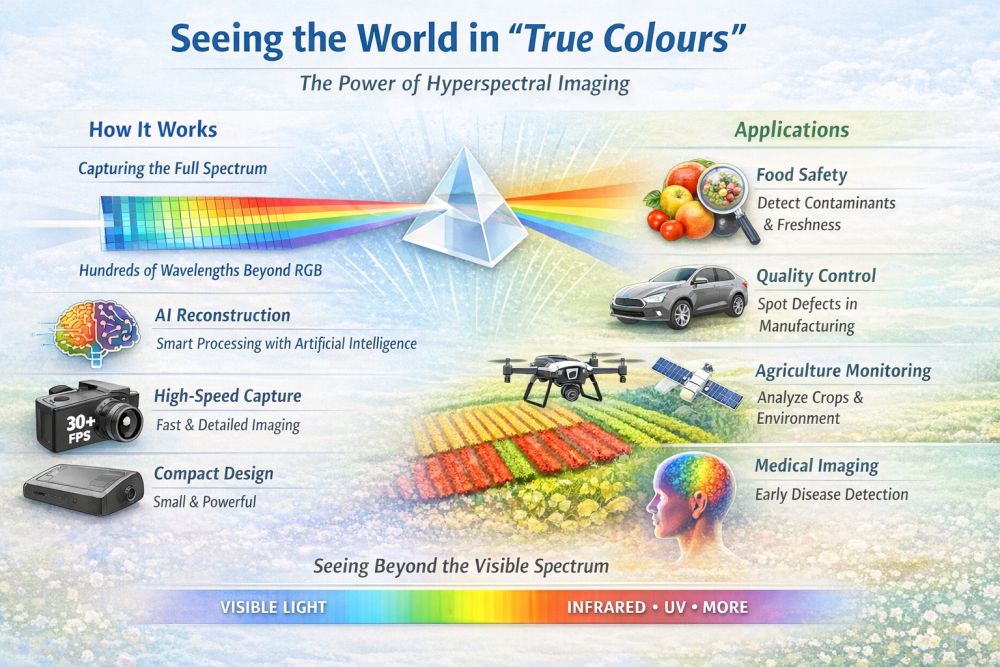
39/2026
In a world filled with digital images—from smartphone photos to satellite maps, what we see is often just a small part of reality. Most cameras, including those in our phones, only capture visible red, green, and blue (RGB) light. However, a new imaging technology called hyperspectral imaging is changing that.
What Is Hyperspectral Imaging?
Imagine a camera that doesn’t just see colors like your eyes do but also detects hundreds of light wavelengths, revealing details invisible to the naked eye. Hyperspectral cameras gather data across multiple bands of the light spectrum, enabling us to uncover hidden information like the chemical makeup of food, tiny flaws in manufacturing, and landscape features from space, making the unseen visible.
How the New Cameras Work
Traditional hyperspectral systems capture light using lenses, prisms, or filters, but these designs can be slow, less sensitive, and bulky. The new generation of hyperspectral cameras combines AI and advanced optics to address these issues.
- AI-Assisted Reconstruction: Instead of handling large amounts of raw data the traditional way, the system uses artificial intelligence to interpret and quickly rebuild the image.
- High Sensitivity at Speed: These cameras can quickly capture detailed spectral information at over 30 frames per second with high resolution — something that was previously impossible without extensive computing power.
- Compact and Practical: The design maintains a camera size similar to current high-end devices while significantly enhancing performance.
Real-World Uses You’ll Care About
How does this impact your life? Hyperspectral imaging isn’t just a lab curiosity. Its practical uses, such as ensuring food safety or improving medical diagnostics, can make you feel that this technology directly benefits you and concerns you.
- Food Safety – Rapidly identify contaminants, spoilage, or quality problems that human eyes or standard cameras might miss.
- Manufacturing Quality Control – Detect subtle defects in products such as vehicles, electronics, and packaging before they leave the production line.
- Agriculture and Environment – Use drones or satellites with hyperspectral sensors to monitor crop health, soil conditions, and water quality from above.
- Medical Diagnostics – Research suggests that future adaptations could help clinicians detect early signs of disease using spectral clues invisible to standard imaging.
Why This Technology Matters
Humans have always relied on sight, from reading a weathered landscape for survival to capturing a beautiful sunset on a smartphone. Highlighting how hyperspectral imaging reveals details beyond visible light can make readers feel intrigued and appreciative of the technology's potential to deepen our understanding of the world.
It’s not just about clearer pictures. Hyperspectral imaging marks a step forward in how we observe reality, revealing insights that were once hidden or too expensive to access. Whether improving food safety, advancing medical research, or powering smarter industrial systems, the ability to see the world in its “true colors” promises benefits that impact everyone’s life.