Generative AI vs. Discriminative AI: Two Ways Machines Learn to Think
Posted 1 month ago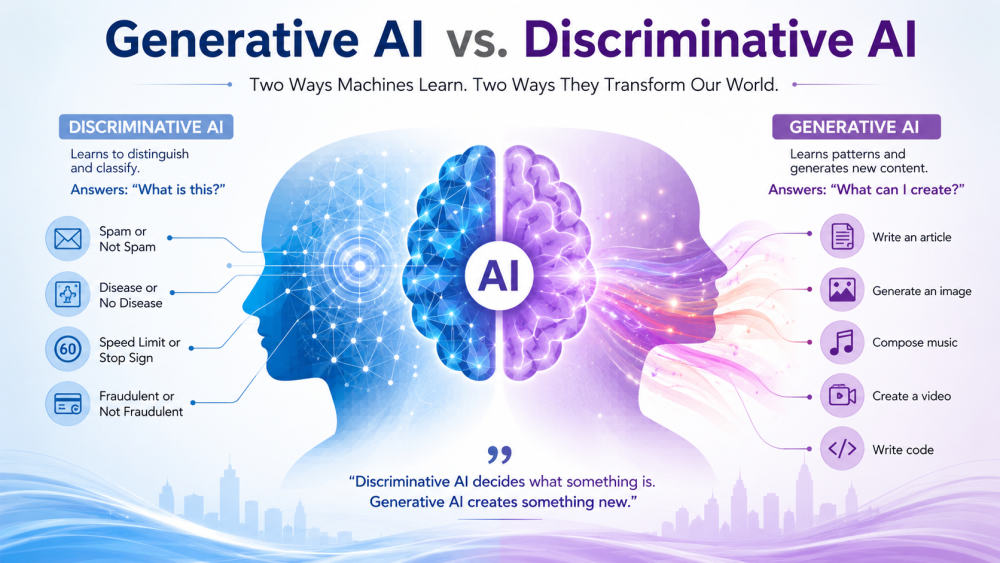
181/2026
Artificial intelligence is often described as machines learning to perform tasks that typically require human intelligence. But not all AI learns the same way. Two important approaches are discriminative AI and generative AI. The simplest distinction is this: discriminative AI determines what something is; generative AI creates something new.
Imagine a doctor examining a medical scan. A discriminative AI system might analyze the scan to determine whether a tumor is present. It learns from thousands of previously labeled scans and becomes skilled at recognizing patterns that distinguish one category from another. Similar systems can identify fraudulent bank transactions, predict whether a customer will cancel a subscription, or determine whether a road sign is a speed-limit sign or a stop sign.
Generative AI works differently. Instead of simply choosing among existing categories, it learns patterns from vast amounts of data and uses them to produce new content. Ask for a generative AI system to write a patient-friendly explanation of diabetes, design a new building concept, compose a piece of music, create computer code, or produce an illustration of a futuristic hospital, and it generates an original response.
A simpler, more relatable example would be a detective and a storyteller:
Imagine a detective examining evidence from hundreds of past cases and deciding whether a new case is likely to involve theft, fraud, or an accident. That is like discriminative AI, which analyzes evidence and makes a classification. A storyteller, however, studies countless stories and then uses the patterns they learn to create a completely new story with new characters and events. That is like generative AI, which uses what it has learned to produce something new.
|
Discriminative AI |
Generative AI |
|
Classifies and predicts |
Creates and produces |
|
Answers: “What is this?” |
Answers: “What can I create?” |
|
Detects patterns |
Learns patterns and generates new outputs |
|
Identifies fraud |
Writes a financial report |
|
Detects disease in an image |
Creates an educational medical illustration |
|
Recognizes speech |
Generates a natural-language response |
|
Recommends whether something belongs to a category |
Produces new text, images, audio, video, or code |
Both approaches depend on training. AI models learn from large amounts of data, often using neural networks and deep-learning techniques. The crucial difference lies in how they use what they have learned. Discriminative models learn the boundaries between possibilities; generative models learn the underlying patterns well enough to produce new possibilities.
Generative AI is also not entirely new. Its foundations trace back decades to neural networks, probabilistic models, and techniques such as generative adversarial networks (GANs) and variational autoencoders (VAEs). The advent of powerful transformers, massive datasets, and modern computing has transformed the field, making today's text-, image-, audio-, video-, and code-generating systems possible.
This distinction explains why generative AI has attracted so much attention. Traditional AI primarily helped machines recognize, predict, and decide. Generative AI adds another dimension: machines can now draft, design, explain, compose, and create.
The important point, however, is that “creative” does not imply human-like understanding or imagination. Generative AI produces novel outputs by learning complex patterns from data. Its remarkable ability to create is therefore a powerful form of pattern-based generation rather than human consciousness.