From Publications to Products: Reinventing the Ph.D.
Posted 3 months ago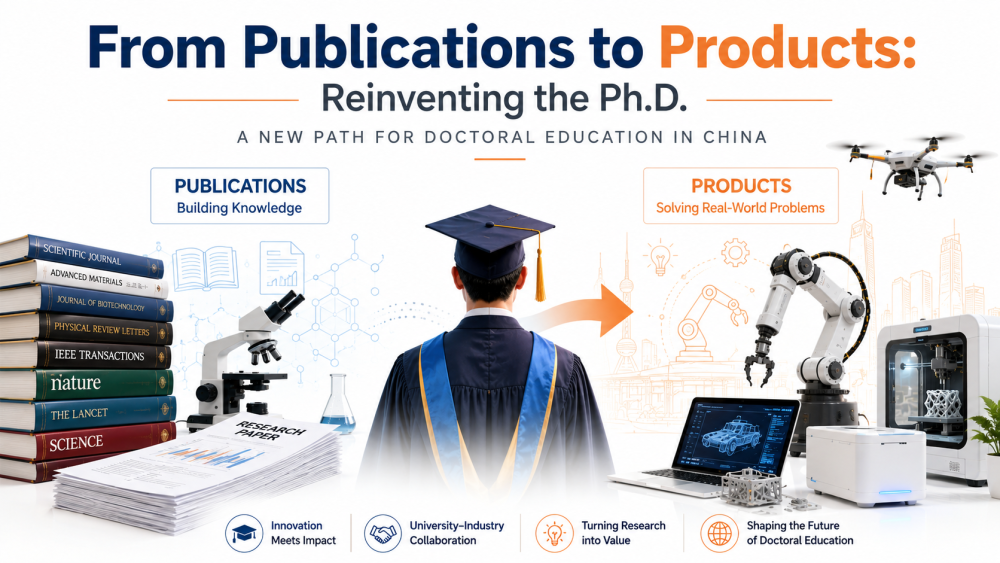
129/2026
Since the implementation of the 2024 law regarding Ph.D.s without a thesis, almost 60 doctoral students have graduated without writing a traditional dissertation, according to a report published in Nature Journal. Instead, they are earning their degrees by developing innovative products, technologies, engineering solutions, and other practical achievements. The bold reform could redefine how universities around the world measure research excellence.
For generations, the doctoral degree has been built on a simple expectation: conduct original research, publish scientific papers, and defend a dissertation. In laboratories and universities around the world, publication has become the currency of academic success.
China is now testing a different idea.
A small but closely watched group of doctoral students has become among the first in the country to earn Ph.D. degrees without meeting the traditional requirement to publish research papers in academic journals. Instead, their work is being evaluated based on the technologies they developed, the engineering solutions they designed, the patents they secured, and products of measurable industrial value.
The initiative is more than an educational experiment. It reflects a broader shift in how nations increasingly approach research, innovation, and economic competitiveness.
For decades, universities have rewarded discoveries primarily through scholarly publications. The system has produced remarkable advances in medicine, physics, engineering, and countless other disciplines. Yet critics argue that it has also encouraged researchers to prioritize papers over practical impact, sometimes producing work that advances academic knowledge but rarely reaches society.
China's alternative pathway poses a different question: What if the most important outcome of doctoral research is not another journal article but a technology that solves a real-world problem?
Under the new model, students continue to conduct rigorous research. The difference is in how that research is evaluated. Rather than measuring success largely by publication records, universities assess innovations such as industrial technologies, software systems, advanced manufacturing processes, and other products developed in partnership with industry.
The approach is especially attractive in fields where discoveries are expected to move quickly from the laboratory to the marketplace. Engineering, artificial intelligence, biotechnology, and advanced manufacturing increasingly rely on researchers who can translate scientific ideas into practical applications.
Supporters believe the model more accurately reflects the careers that many Ph.D. graduates ultimately pursue. Around the world, an increasing share of doctorate holders works outside universities, joining technology companies, research institutes, hospitals, and manufacturing industries. For these graduates, experience in product development and technology transfer may prove as valuable as a list of journal publications.
The initiative also strengthens ties between universities and industry. By embedding doctoral students in projects with commercial or societal relevance, universities aim to shorten the often-lengthy path from scientific discovery to practical innovation.
Still, the experiment raises difficult questions.
Peer-reviewed publications have long served as an internationally recognized benchmark of scientific quality, providing independent scrutiny and a permanent scholarly record. To fully understand China's new evaluation approach, it is essential to compare it with traditional standards and explore how alternative assessments can ensure research integrity and rigor.
Some scholars worry that emphasizing commercial outcomes and technological achievements could divert attention from fundamental research, the curiosity-driven science that often yields breakthroughs like quantum mechanics or DNA. Balancing innovation with foundational science remains a critical challenge in reforming doctoral assessment models.
Others see no contradiction between the two approaches. Basic science and applied innovation, they argue, are complementary rather than competing missions. Universities can continue to nurture foundational research while recognizing that innovation sometimes takes the form of a working technology rather than a published manuscript.
China's experiment comes as governments worldwide seek higher returns on public research investments. This development underscores the importance of the audience's role in ensuring that universities contribute not only to knowledge but also to economic development, societal well-being, and the addressing of global challenges such as climate change and public health.
Whether the new doctoral pathway will become a model for other countries remains uncertain. The program is still in its early stages, and educators will closely monitor the careers of its graduates, the quality of their work, and the broader impact on scientific research.
Yet the initiative highlights a question that universities everywhere may eventually confront, inspiring the audience to think about how their institutions could adapt and lead in redefining research success in the twenty-first century.
In the twenty-first century, should a doctorate be defined solely by what researchers publish or also by what they build?
The answer may shape not only the future of doctoral education but also how societies assess the true value of scientific discovery.