APSUP South Punjab Chapter to Convene Regional Roundtable of the 7th Rectors’ Conference 2026
Posted 1 day ago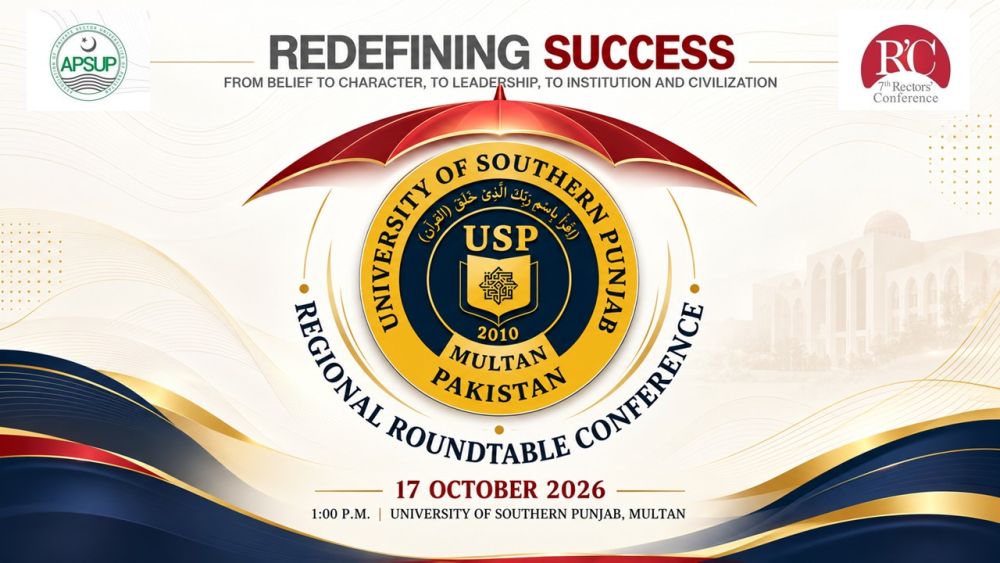
244/2026
The Association of Private Sector Universities of Pakistan (APSUP), South Punjab Chapter, will convene its Regional Roundtable Conference tomorrow at the University of Southern Punjab (USP), Multan, bringing together Vice-Chancellors, Rectors and senior academic leaders to deliberate on the evolving purpose of higher education and the future direction of universities in Pakistan.
Mr. Asim Nazir Ahmad, President of the APSUP South Punjab Chapter, will chair the conference, with Prof. Dr. Sumaira Rehman, Rector of Superior University, serving as Chief Guest and facilitator of the discussion. Several Vice Chancellors and academic leaders have confirmed their participation. The gathering will provide a platform for Vice Chancellors and academic leaders to exchange perspectives, examine institutional challenges, and develop a broader understanding of university success beyond conventional performance indicators.
Organized as a pre-conference initiative ahead of the 7th Rectors’ Conference, scheduled for December 3–5, 2026, at COMSTECH, Islamabad, the regional roundtable will contribute to the national dialogue on the future of higher education. The forthcoming Rectors’ Conference will feature the theme “Redefining Success: From Belief to Character, to Leadership, to Institution and Civilization.”
The working paper for the roundtable challenges universities to look beyond rankings, research publications, accreditation, graduate employment, and financial sustainability as the sole measures of achievement. While recognizing their importance, it argues that a university's deeper success must also be reflected in its graduates' character, its leadership's ethical conduct, the integrity of its institutional practices, and its contribution to society.
Pakistan’s expanding higher education sector faces a defining question: are universities merely preparing graduates for employment, or are they also cultivating responsible citizens, principled leaders, and individuals capable of contributing meaningfully to national progress?
The roundtable will explore a five-dimensional framework linking belief, character, leadership, institutions, and civilization. Drawing on the Islamic intellectual tradition and contemporary research on education and leadership, the framework proposes that belief provides purpose, character translates purpose into conduct, leadership transforms character into collective action, and institutions sustain that action through systems of fairness, accountability, and trust. Ultimately, these processes shape universities’ broader contribution to human flourishing and civilizational development.
Discussions will address four central questions: how universities can assess character development alongside academic achievement and employability; how ethical and responsible leadership can be integrated into students’ educational experiences; what institutional reforms can strengthen transparency, fairness, and accountability; and how universities can contribute more effectively to Pakistan’s social and economic development.
The conference comes at a time when artificial intelligence, digital transformation, and shifting labor-market demands are reshaping professional life. Graduates increasingly need not only technical knowledge but also critical thinking, resilience, sound judgment, collaboration, and a strong sense of responsibility. Universities must therefore prepare students to navigate complexity while upholding ethical principles and serving the public good.
The working paper also emphasizes that institutional culture is shaped not only by written policies but also by how rules are implemented, merit is recognized, disagreements are handled, and authority is exercised. It calls for university leadership to be understood as a responsibility grounded in trust, consultation, and accountability rather than simply a position of authority.
Mr. Asim Nazir Ahmad, President of the APSUP South Punjab Chapter, said the regional roundtable would offer an important opportunity for university leaders to collectively reflect on the purpose of higher education and identify practical approaches to strengthening educational quality, leadership, and institutional responsibility.
The deliberations are expected to contribute regional perspectives to the broader national conversation during the 7th Rectors’ Conference in December.
By bringing academic leaders together around a shared vision of educational success, the APSUP South Punjab Chapter aims to foster constructive dialogue about universities as institutions that do more than award degrees: they cultivate character, develop responsible leadership, build public trust, and help shape a more capable, ethical, and prosperous society.