231/25 Rebuilding Leadership in Universities Through Character Education - APSUP South Punjab Chapter Report on Prof. Dr. Sumaira Rehman Lecture
Posted 10 months ago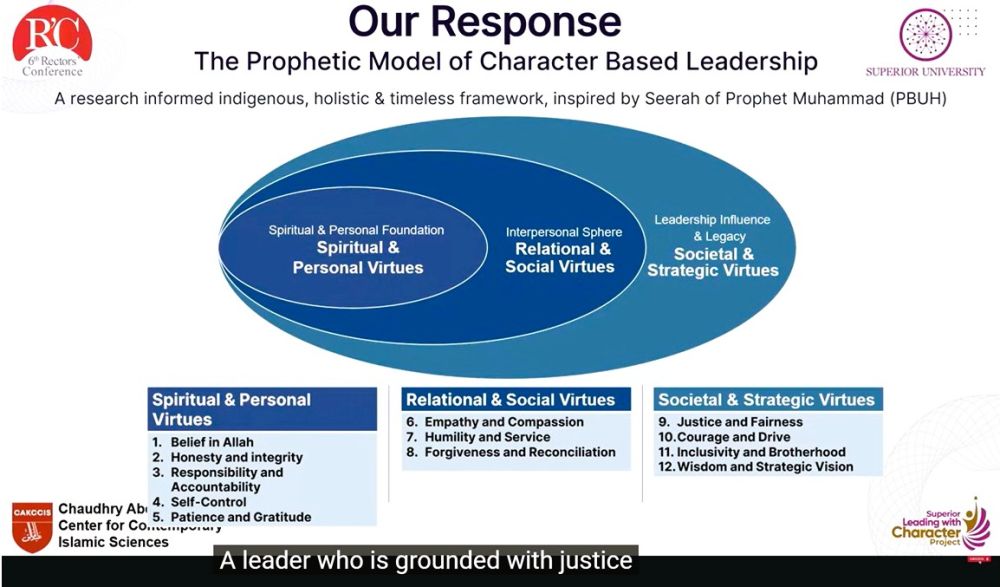
You can watch Prof. Dr. Sumaira Rehman lecture HERE
When Prof. Dr. Sumaira Rehman rose to speak, her voice worn by a sore throat yet unwavering in conviction, she posed a question that highlights the critical need for character in modern leadership:
How can an age defined by extraordinary education simultaneously suffer an unprecedented leadership crisis?
For Dr. Rehman, Rector of the Superior University, the diagnosis is stark. “It is not a crisis of knowledge, it is the crisis of character.” She described that we are living in a "Leadership challenge of our age."
What followed was a rare moment in Pakistan’s higher education discourse: an academic leader emphasizing moral transformation over technological or ranking achievements, highlighting her leadership approach.
Dr. Rehman’s argument was rooted in a simple observation: despite producing graduates with world-class degrees, societies across the globe remain rife with corruption, dishonesty, polarization, and ethical decay.
“We equip students with skills but not with the values of honesty, integrity, and service,” she said. “We encourage competition but forget compassion.”
This dissonance, she argued, lies at the heart of today’s leadership deficit. Universities, traditionally the sanctuaries of wisdom and guardians of civilizational values, have drifted toward metrics, grades, and rankings at the expense of moral formation.
Her team’s research confirmed this gap. Stakeholders across the board, ambassadors, employers, students, and faculty, identified “character” as the most absent yet most essential quality in higher education today.
According to Prof. Dr. Sumaira Rehman, rather than lament the deficit, Superior University chose to act.
Reimagining Leadership: From the Inside Out
In her presentation, Dr. Rehman shared the retrospective of the 'Leading with Character' project, launched two years ago at Superior University to cultivate ethical leadership rooted in moral virtues.
Its conceptual foundation is both timeless and radical: the prophetic model of character-based leadership inspired by the life of Prophet Muhammad (peace be upon him). Dr. Rehman emphasized that the 12 virtues drawn from this model, honesty, patience, empathy, humility, justice, courage, fairness, and others, are not religious ideals but “the blueprint for ethical leadership.”
The project rests on an inside-out philosophy: leadership must begin with personal moral grounding before extending to interpersonal relationships and, ultimately, societal influence.
The model’s three spheres include:
1. Personal Virtues
Belief, honesty, integrity, responsibility, accountability, self-control, patience, and gratitude.
2. Relational Virtues
Empathy, compassion, humility, service, forgiveness, reconciliation.
3. Societal Virtues
Justice, fairness, courage, inclusivity, wisdom, vision.
“A leader grounded with these virtues can navigate adversity and make ethical decisions,” Rehman said. “They can build institutions and societies that flourish for generations.”
Character as Institutional DNA
According to Prof. Dr. Sumaira Rehman, the Superior University integrated this model into every visible and invisible layer of campus life.
- Character was no longer an add-on; it became a strategic pillar of identity.
- Faculty and staff transitioned into moral educators, undergoing rigorous professional development.
- Students embarked on a 3-year curricular journey and a mandatory leadership course focusing on character competencies.
- Sports and adventure-based learning were reframed as “character laboratories.”
- Quality assurance systems incorporated character domains into feedback tools.
Teams were restructured into hierarchical clusters, Alpha, Bravo, and Charlie, to ensure that character remained operational rather than rhetorical.
The transformation demanded immense investment: both fiscal and “thousands and thousands of man-hours,” according to Rehman. But she insists the returns were priceless.
Inside the Character Boot Camp
Among the most striking interventions was a 45-day leadership boot camp anchored in the prophetic virtues. Participants evaluated their character strengths, underwent assessments, wrote reflective journals, solved real-life moral dilemmas, and developed personal improvement plans.
Those who succeeded entered a four-month applied phase called My Character, My Superpower, in which they documented day-to-day scenarios in which they practiced the 12 virtues. Over 5,000 scenarios were submitted, and 350 of the most impactful have been compiled into a forthcoming book.
The journey culminated in a deeply symbolic reward: a leadership retreat in Makkah and Madinah for faculty who demonstrated exceptional dedication.
They returned with a renewed sense of purpose, she recalled, “fully committed to reshaping not just our students’ lives but society itself.”
The Culture Shift: Numbers and Narratives
Two years into the experiment, Dr. Rehman presented outcomes with visible pride.
- Student satisfaction rose significantly.
- Faculty commitment and integrity strengthened.
- Enrollment increased.
- Retention improved.
- Traditional teams evolved into performing teams.
But the bigger change, she said, is cultural.
The university now breathes a purpose-driven ethos—one where service leadership, humility, and collective responsibility shape daily life.
“This is not just a project,” Rehman told the audience. “It is a paradigm shift.”
She credited the vision of Professor Dr. Chaudhry Abdul Rehman, the “architect, dreamer, and implementation champion” of the initiative, whose leadership she described as the soul of the transformation.
A Call to the Nation’s Universities
As she concluded, Dr. Rehman issued a national call to action:
“If we want ethical leaders tomorrow, we have to teach character today. Character is contagious.”
She invited universities across Pakistan to join the movement, offering Superior University’s team to train faculty from any institution seeking meaningful transformation on a voluntary basis.
In her final words, she delivered a sentiment that could well serve as the manifesto of a new educational era:
“Good higher education is good character education.”
The applause that followed suggested that for many in the room, this was more than a speech; it was a wake-up call to rebuild universities not from the top down, but from the inside out.